2026-08-28T14:10:06.593Z ·
Why Is My Air Conditioner Not Blowing Cold Air?
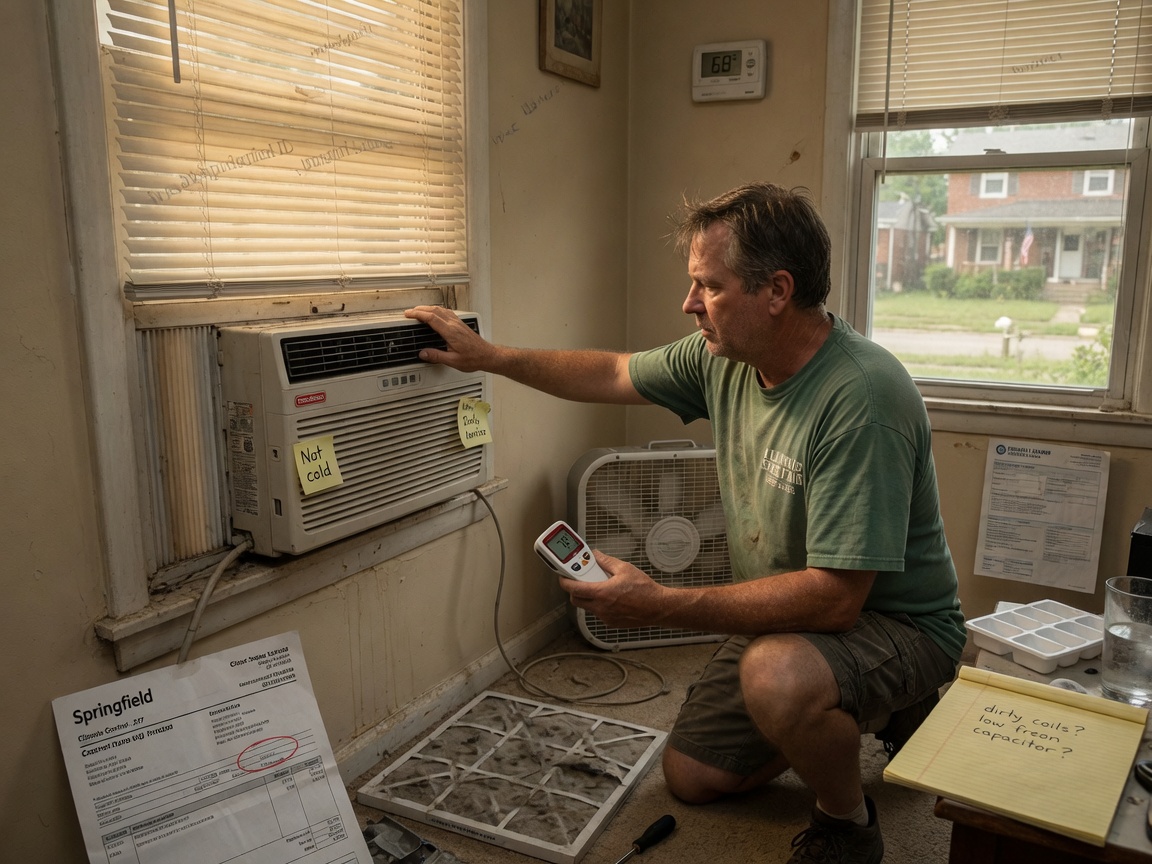
An air conditioner that runs but does not blow cold air is most often caused by one of five things: a failed run capacitor stopping the compressor while the fan keeps turning, low refrigerant from a leak, a clogged air filter choking airflow across the evaporator coil, a dirty outdoor condenser coil unable to reject heat, or a frozen evaporator coil. Of those, only the filter is something you can resolve yourself in a few minutes. The rest need gauges and electrical testing.
Start with the filter, because it is free to check and it genuinely is the cause a fair share of the time. Pull it out and hold it up to a light. If you cannot see light through it, it is restricting airflow badly enough to matter. A starved evaporator coil cannot absorb heat properly, output drops, and in the worst case the coil ices over and airflow stops almost entirely. Filters in Springfield homes load faster than the packaging suggests, particularly during spring pollen and through the agricultural dust of late summer.
Next, go outside and listen to the condenser. You want to hear two things: the fan turning and a lower hum from the compressor underneath it. If the fan is spinning but there is no compressor hum, the run capacitor has very likely failed. This is by a distance the most common single AC fault we see, and it is also one of the cheaper ones, typically $180 to $400 to put right. The capacitor delivers the electrical kick that starts the compressor, and when it dies the fan carries on happily while the part that actually produces cooling never starts.
If the outdoor unit is not running at all, check your breaker panel and the disconnect box on the wall near the condenser. A tripped breaker can be a one-off nuisance trip, so resetting it once is reasonable. If it trips again immediately, stop. A repeatedly tripping breaker means a genuine electrical fault, most often a shorted compressor or a failing fan motor, and resetting it repeatedly risks damage well beyond the original problem.
Low refrigerant is the cause people most often assume and it is less common than the assumption suggests, but it does happen. Refrigerant is not consumed in normal operation, so a system low on charge has a leak somewhere. Warning signs are ice forming on the copper line at the outdoor unit, a hissing or bubbling noise, and cooling that has faded gradually over a season rather than stopping suddenly. The important point is that simply adding refrigerant without finding the leak is money spent on a temporary result, and on older R-22 systems the refrigerant cost alone can push you toward replacing the system.
A frozen evaporator coil produces a specific and recognizable picture: the system runs constantly, almost no air comes from the registers, and there is ice visible on the indoor coil or the refrigerant line. Freezing is caused by either restricted airflow or low refrigerant, so it is a symptom rather than a root cause. Turn the system off and run the fan alone for a few hours to thaw it before anyone tries to diagnose the underlying problem, because a technician cannot take useful readings on an iced system.
A dirty condenser coil is worth checking visually, and it is common here. The outdoor unit rejects the heat pulled from your house through those fins, and a mat of cottonwood, grass clippings and field dust blocks that transfer. You can see it by looking at the fins from the side. Gentle rinsing from the outside in with a garden hose helps, though the deeper fouling that develops over years needs proper coil cleaning with the unit opened up.
One last check before calling anyone: confirm the thermostat is set to cool, that the setpoint is genuinely below the current room temperature, and that the fan is on auto rather than on. Fan set to on runs the blower constantly, including when the compressor is off, so you feel room-temperature air moving and reasonably conclude the AC has failed. It sounds trivial and it accounts for more service calls than most people would guess.
If the filter is clean, the thermostat is right, the breaker holds, and the outdoor unit either sits silent or runs without a compressor hum, that is the point to call. Capacitors, contactors and fan motors are same-visit repairs in most cases. Refrigerant leaks take longer because the leak has to be located before it is worth recharging anything. Either way, the diagnosis costs $89 to $129 and tells you which of those you are dealing with, which is the thing you cannot determine from the outside.