2026-07-27T14:10:06.593Z ·
Do You Need a Whole House Humidifier in Illinois?
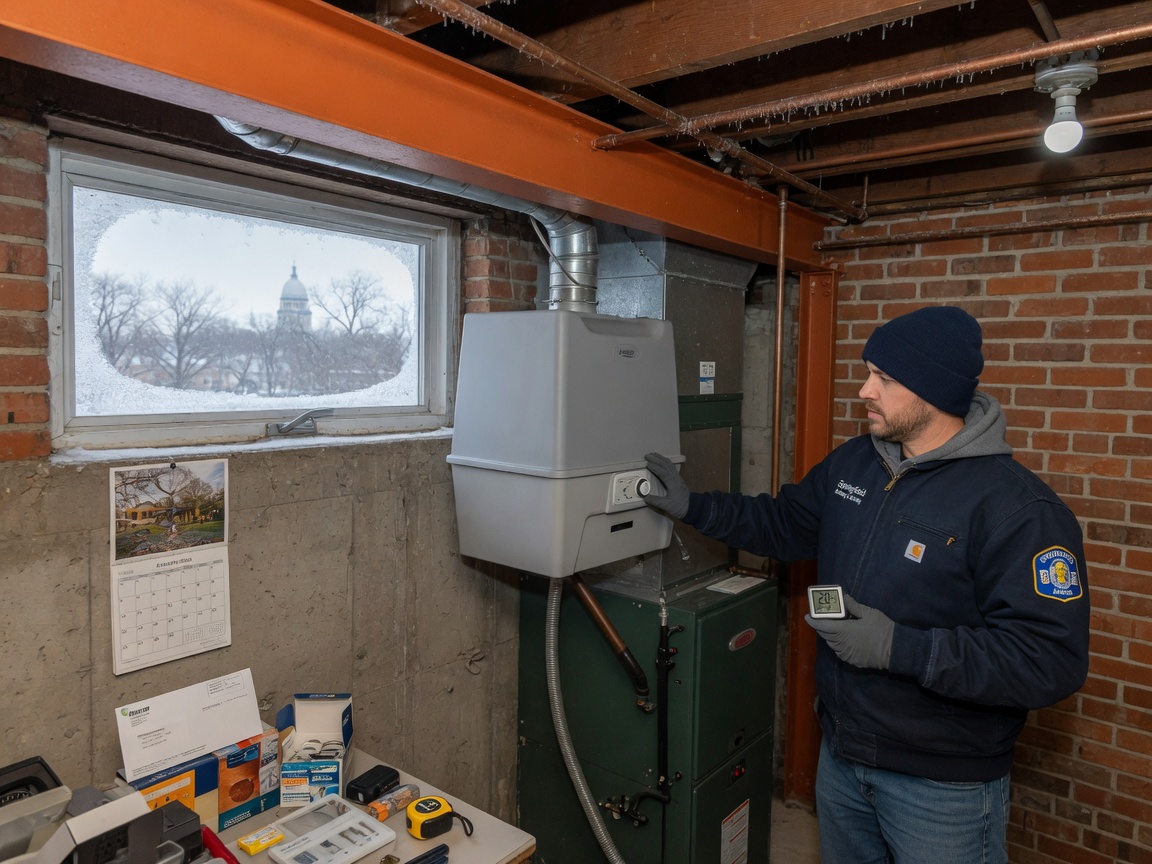
A whole-house humidifier is worth installing in Central Illinois if you have hardwood floors, solid wood trim or furniture you care about, or if you experience constant static shocks and dry sinuses through winter. Installation costs $600 to $1,200 for a bypass unit and $1,400 to $2,500 for a steam system. The wood damage argument is the strongest one, because it is cumulative, expensive and completely preventable.
The underlying physics explains why Illinois winters are so drying. Cold air holds very little moisture. When outdoor air at 20 degrees and 70 percent relative humidity enters your house and gets heated to 70 degrees, that same moisture content becomes roughly 15 percent relative humidity indoors. That is drier than most desert climates, and it is happening inside a heated house in Springfield every January.
Wood responds to that by giving up moisture and shrinking. Hardwood floors develop visible gaps between boards. Trim and baseboards pull away from walls. Furniture joints loosen, and solid wood doors and drawers change fit. Musical instruments crack. Most of this reverses partially in summer as humidity returns, but repeated cycling causes permanent damage, and refinishing a floor costs several times what a humidifier does.
The comfort effects are what people notice first. Constant static shocks off doorknobs and pets, dry and itchy skin, cracked lips, irritated nasal passages and morning sore throats, and nosebleeds in dry-prone individuals. There is also a temperature effect worth knowing: drier air feels colder at the same thermostat setting because evaporation from your skin accelerates. Raising humidity often lets people set the thermostat a degree or two lower and feel the same, which offsets part of the running cost.
There are three types and the choice is mostly about home size. Bypass humidifiers, at $600 to $1,200, mount to the ductwork and use furnace airflow to evaporate water off a wet pad, and they suit most Springfield homes well. Fan-powered units, at $900 to $1,600, add their own fan for higher output in larger homes. Steam humidifiers, at $1,400 to $2,500, boil water to produce vapor, deliver the most moisture, and work independently of whether the furnace is running, which suits large or very tightly sealed homes.
Setpoint matters as much as equipment, and getting it wrong causes its own problems. Aim for 35 to 45 percent, and reduce toward 30 percent during hard freezes. Push too much moisture during extreme cold and it condenses on window glass and, more seriously, inside wall cavities where you cannot see it. A humidistat with an outdoor temperature sensor makes that adjustment automatically and is worth the extra $150 to $300 for exactly this reason.
Maintenance is modest but genuinely necessary. The evaporator pad needs replacing annually, and Springfield water leaves noticeable mineral deposits that clog a pad faster than soft water would. An unmaintained humidifier stops working quietly, so people often assume the equipment failed when the pad simply needs changing. Folding the pad replacement into your annual furnace tune-up keeps it from being forgotten.
Who does not need one? Homes that already run humid, which in Illinois usually means a moisture problem worth investigating rather than a comfort win. If you see condensation on windows before installing anything, or you have a damp basement, adding moisture is the wrong move and the moisture source needs finding first. An air quality assessment will measure what your humidity actually is across the house rather than guessing, and that is the right starting point when the picture is unclear. Our humidifier installation page covers the options.