2026-08-12T14:10:06.593Z ·
Mini Split Cost: What Ductless Systems Cost Installed
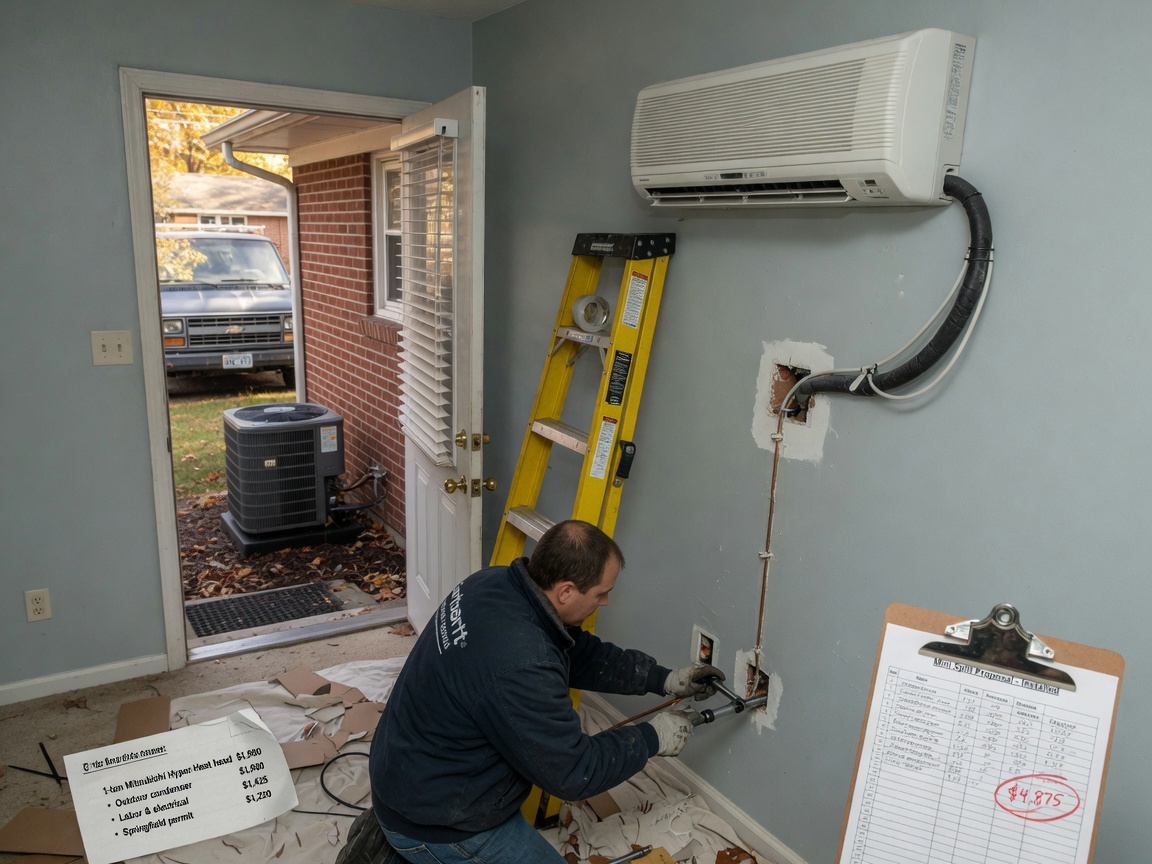
A single-zone ductless mini split costs $3,500 to $6,000 installed in the Springfield area, with smaller 9,000 to 12,000 BTU units at the lower end and 18,000 to 24,000 BTU units toward the top. Multi-zone systems, where one outdoor unit serves several indoor heads, run $7,000 to $10,000 for two zones and $10,000 to $15,000 for three or four. Cold-climate rated equipment adds $1,000 to $2,500 and is generally worth it here.
Mini splits earn their place in specific situations rather than as a general replacement for ducted systems. The clearest cases in Central Illinois are garages and workshops in year-round use, converted attics and bonus rooms over garages that the main system cannot keep up with, sunrooms and four-season porches, additions where extending the existing system would overload it, and older homes with boiler or radiator heat and no ductwork at all.
Garage conditioning is the single most common request we get, and it comes with a prerequisite. A mini split can absolutely make a Springfield garage comfortable through both January and July, but only if the garage has some insulation and a reasonably sealed overhead door. An uninsulated garage with a leaky door defeats any heating or cooling system you install, and spending on insulation first makes the mini split both smaller and cheaper.
Because mini splits are heat pumps, they heat as well as cool, which is most of their appeal for a workshop. The same cold-weather rules apply as for any heat pump: check the rated capacity at low outdoor temperature rather than the headline BTU figure, since output falls as it gets colder. Cold-climate models hold usable capacity well below freezing, which matters in a climate that reaches single digits.
Sizing errors hurt mini splits more than ducted systems. These units are designed to run continuously at low output, modulating to hold temperature, and that is where their efficiency and their comfort both come from. An oversized head reaches setpoint fast, shuts off, and cycles, which throws away the advantage you paid for and can leave a room feeling humid in summer. Bigger is not safer here.
DIY kits with pre-charged line sets are widely sold and people do install them, so it is worth being clear about where they go wrong. The failure points are handling the line set without contaminating it, achieving and holding a proper vacuum before releasing the charge, and the electrical connection. Getting any of those wrong shortens compressor life and generally voids the warranty. If you have already installed one and it underperforms, diagnosis is worthwhile, since the fault is usually charge or vacuum related.
Running costs compare well against the alternatives for the spaces mini splits typically serve. Against electric resistance heat in a garage, a mini split delivers several times the heat per unit of electricity. Against extending ductwork to an addition, the installed cost is usually lower and there is no duct loss to account for. Against a window unit, the efficiency and the noise difference are both substantial.
Maintenance is modest but not zero. Filters in the indoor heads need washing every few weeks during heavy use, and the blower wheel needs a deep clean periodically, because a film accumulates there that filter cleaning does not reach. That film is the most common cause of a mini split that has quietly lost output over a few years without throwing any fault code. Our installation page covers configuration options in more detail.