2026-07-31T14:10:06.593Z ·
What Is Included in a Furnace Tune Up?
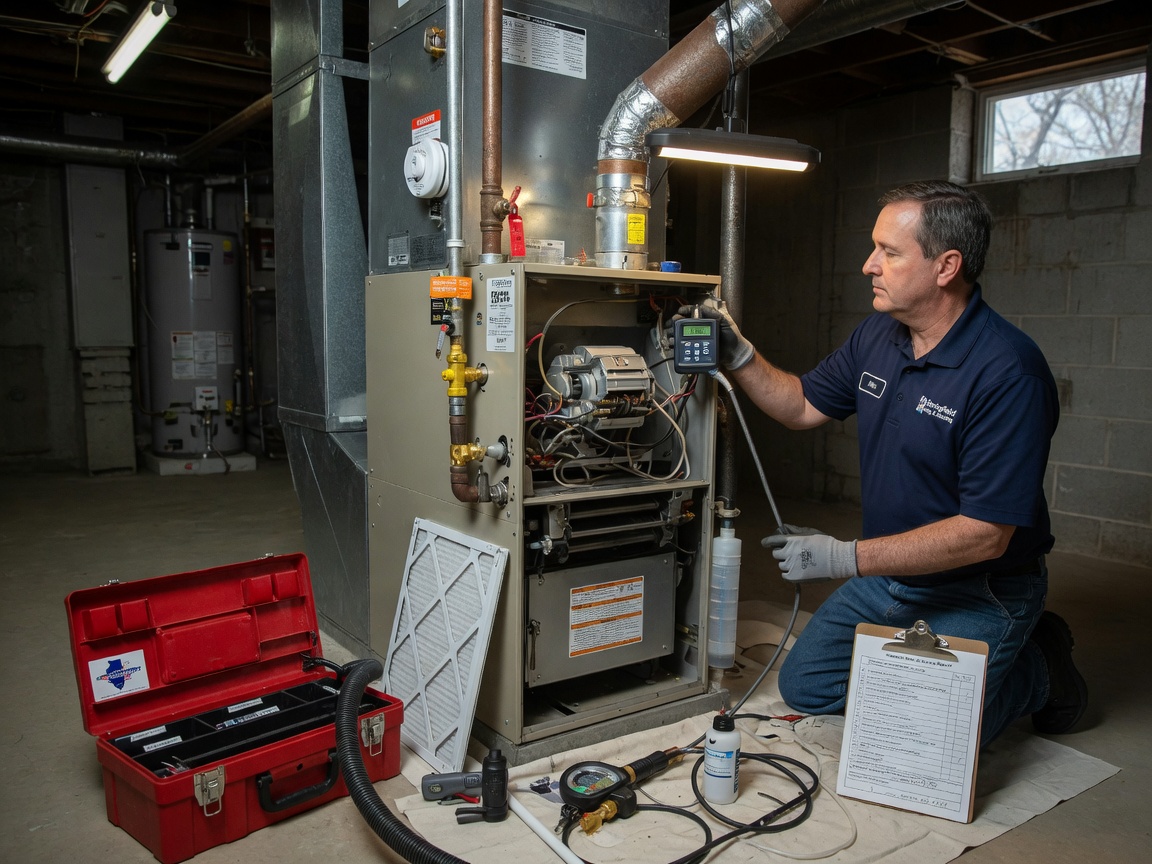
A furnace tune-up should include a heat exchanger inspection, combustion analysis at the flue, flame sensor cleaning, burner inspection, gas pressure verification, pressure switch and inducer testing, limit switch checks, blower cleaning with amp draw readings, and carbon monoxide testing in the living space. It costs $99 to $179 in the Springfield area. The heat exchanger inspection is the item that justifies the visit on its own.
That inspection matters because a cracked heat exchanger can allow combustion gases, including carbon monoxide, into the air your blower distributes through the house. Cracks develop gradually from thermal stress over many heating cycles, and they do not announce themselves. By the time symptoms are obvious, whether soot, a yellow burner flame, an unusual smell or an alarm sounding, the crack is well established. This is the clearest example in this trade of maintenance that is genuinely about safety rather than efficiency.
Combustion analysis is the second item worth the money. A technician measures the flue gases to confirm the furnace is burning fuel completely and venting properly. This reveals incomplete combustion, a restricted or partially blocked flue, and gas pressure that has drifted out of specification. None of it is visible from outside the cabinet, and all of it affects both safety and how much fuel you are spending to produce heat.
Flame sensor cleaning is the most practically valuable routine item, because a dirty flame sensor is the single most common cause of a no-heat call in Springfield. The sensor confirms to the control board that a flame has actually lit, and a thin carbon film on it is enough to break that signal, so the board shuts the gas valve as a safety response. The furnace tries a few times and locks out. Cleaning it in October costs a fraction of an emergency callout in January.
The other routine checks catch failures that follow predictable patterns. Inducer motor bearings wear and get noisy before they seize. Pressure switch tubing cracks or fills with condensate. Condensate traps on high-efficiency units clog with the biological growth that thrives in them. Blower amp draw rising above specification indicates a motor heading toward failure. Each of these is cheap to address during a scheduled visit and disruptive to address at 2am in a cold snap.
Not everything on a maintenance checklist carries equal weight, and it is fair to know which is which. Filter replacement is worth doing but you can do it yourself for a few dollars. Thermostat calibration rarely reveals anything on a modern digital unit. Lubrication applies only to older motors with oil ports, since most current blower motors are sealed. These items are real work, they are just not the reason to book.
September and October are the right months in Springfield. Booking then means the schedule is clear, the technician has time to work carefully, and any part that needs ordering arrives before you actually need heat. Wait until December and you are competing with no-heat emergencies, which will rightly get priority, and a part on backorder becomes a genuine problem rather than an inconvenience.
If your system also has cooling, booking both visits together typically costs $170 to $280 rather than paying twice. The cooling-side visit has a narrower value case, mostly coil cleaning and capacitor testing, but combining them saves a trip charge. It is also worth checking your equipment warranty, since many manufacturers require documented annual service to keep parts coverage valid, and homeowners breach that condition without realizing surprisingly often. Our furnace tune-up page lists everything we cover.